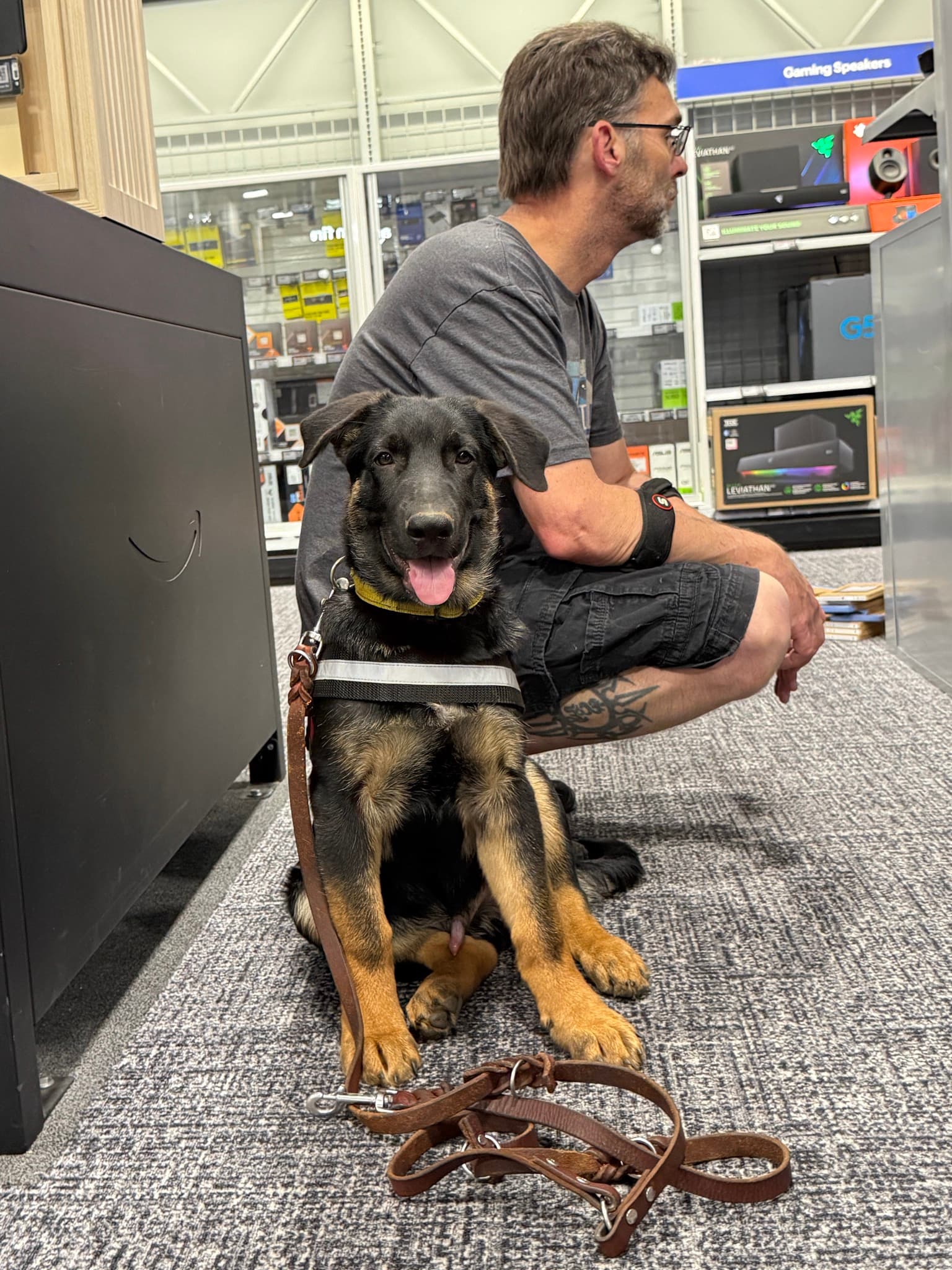
The three-to-six-month window is where I start training, but I am not fully focused yet. That probably sounds contradictory to anyone who has never raised a working dog, so let me clarify what I mean. This is not the stage where the puppy goes everywhere with me and performs flawlessly in every environment. This is the stage where the puppy starts getting some actual public access work in carefully controlled settings — short trips, predictable environments, and a whole lot of contingency planning for when things go sideways. Because they will go sideways. They are puppies. That is what puppies do.
During this window, I start taking the puppy to places like Lowe's. Lowe's is pet-friendly, which makes it an ideal training ground because I can bring the dog in with a jacket on or with the jacket off, and that distinction matters more than most people realize. When the jacket is on, the puppy is learning that it cannot be pet. Strangers can ask, but the answer is no. The focus stays on me. When the jacket is off, the puppy learns that socialization is allowed. People can pet. The world can be friendly. The dog learns to toggle between working mode and off-duty mode based on a visual cue that is consistent and clear.
I also get permission from specific stores that do not typically allow pets — stores where I know the managers personally and where they understand that I am actively training a service dog prospect. Grocery stores, for example. Best Buy. These environments are more complex than a hardware store. Grocery stores have food everywhere, and that is a massive distraction for a young dog who is still figuring out what is and is not acceptable behavior. Best Buy has carpeting, and carpeting presents its own unique problem. Some puppies see carpet and mentally categorize it the same way they categorize grass. They assume it is an acceptable place to relieve themselves. It is not, obviously, but the puppy does not know that yet. That is why I always carry a cleanup kit that can handle anything and everything the puppy throws at me. Accidents happen. They are living creatures. My job is to manage the fallout and reinforce the correct behavior without turning every mistake into a disaster.
I work very heavily on teaching the dog to go to the bathroom on command. It does not always work in public — stress, distraction, and unpredictability all interfere with a young dog's ability to perform reliably — but I always make sure they relieve themselves before we leave the house. My trips away from the house during this stage are very short. We are not spending two hours in Target. We are doing a quick loop, maybe ten or fifteen minutes, and then heading home before the puppy hits its limit. Puppies have short attention spans and even shorter bladders. Pushing them too hard too early does not build a better working dog. It builds a stressed, overtired dog who starts making poor associations with public spaces.
During this phase, I also take the puppy through drive-throughs so they see people walk up to the car. This helps prevent barrier syndrome, which is what happens when a dog learns that it is acceptable to react aggressively or protectively when someone approaches the vehicle. A service dog cannot afford that behavior. They need to understand that people approaching the car — or approaching the handler in general — is routine and nonthreatening. Drive-through windows are perfect for this because the interaction is brief, predictable, and happens repeatedly in the same context.
The other thing I do constantly, all day long, is medical alert training. My dogs are trained to alert when I cough. Sometimes the cough is fake. Sometimes it is real. At this stage, the puppy is learning to recognize the pattern and respond immediately by physically hitting me to get my attention. My current puppy, who is not even four months old yet, has the alert down so heavily that he has already told me twice that I needed to take Benadryl because I had some sort of exposure and did not realize it. Twice. At three months old. He has done his real job as a service dog — alerting me to a medical condition before it became critical — and he is still a baby. That is not normal. That level of sensitivity and drive is extraordinary, and I am honestly amazed by his quality and capability.
He is also going to be massive. He is a very big boy for his age, which is not great for tucking under tables, but it still makes me happy. Simple pleasures. He is cuddly when I need him to be. He is not cuddly when I need him to work. He is very focused. He already has a really strong work ethic, which is absolutely amazing for a puppy, but you do have to realize he is still a puppy. His work ethic is very short. He works hard when he is working, though. He works so hard that he almost knocked me off a stool the other day. I had ordered DoorDash and did not realize I was eating something that contained an allergen. I started coughing while watching TV, completely unaware of how serious it was becoming, and he literally almost knocked me off the stool to get my attention. I stopped eating. I took Benadryl. I survived the scenario. That is a pretty normal thing for me — I get exposures and experience anaphylaxis pretty regularly. Most of the time Benadryl is enough. Every once in a while it is not. But with him alerting me sooner rather than later, I am actually going to have fewer instances where I need the hospital. That makes me extremely happy. It means he is literally doing his job already, and I am very, very ecstatic with him.
But here is the important part that people need to understand: the actual hardcore, he-goes-everywhere-with-me public access training does not start with any of my dogs until they are six months old and I am one hundred percent positive that they are potty trained and will not go to the bathroom inside of a building. Accidents happen. They are living things. But for the most part, that reliability has to be true before I start real public access work. Until then, everything I do is controlled exposure. Short trips. Managed environments. Permission secured ahead of time. The puppy is learning the framework, but they are not carrying the full weight of the job yet.
That is what the three-to-six-month window looks like. It is not glamorous. It is not Instagram-perfect. It is cleanup kits, short trips, fake coughs, and a whole lot of reinforcement for behaviors that will matter later when the stakes are higher. It is also the stage where you start to see which puppies have what it takes. Drive, focus, sensitivity, resilience — those traits show up early if they are going to show up at all. And when they do, it is something to be quietly, fiercely grateful for.
Because sometimes a three-month-old puppy surprises you by doing the job you have been training him for before you even expected him to try. And when that happens, you realize you are not just raising a dog. You are raising a partner who might one day stand between you and the kind of emergency that does not wait for anyone to be ready.
Strength stands watch.
And so do I.
Wendi Coffman-Porter
Real handler, real stories, real dogs. - FurPower.org