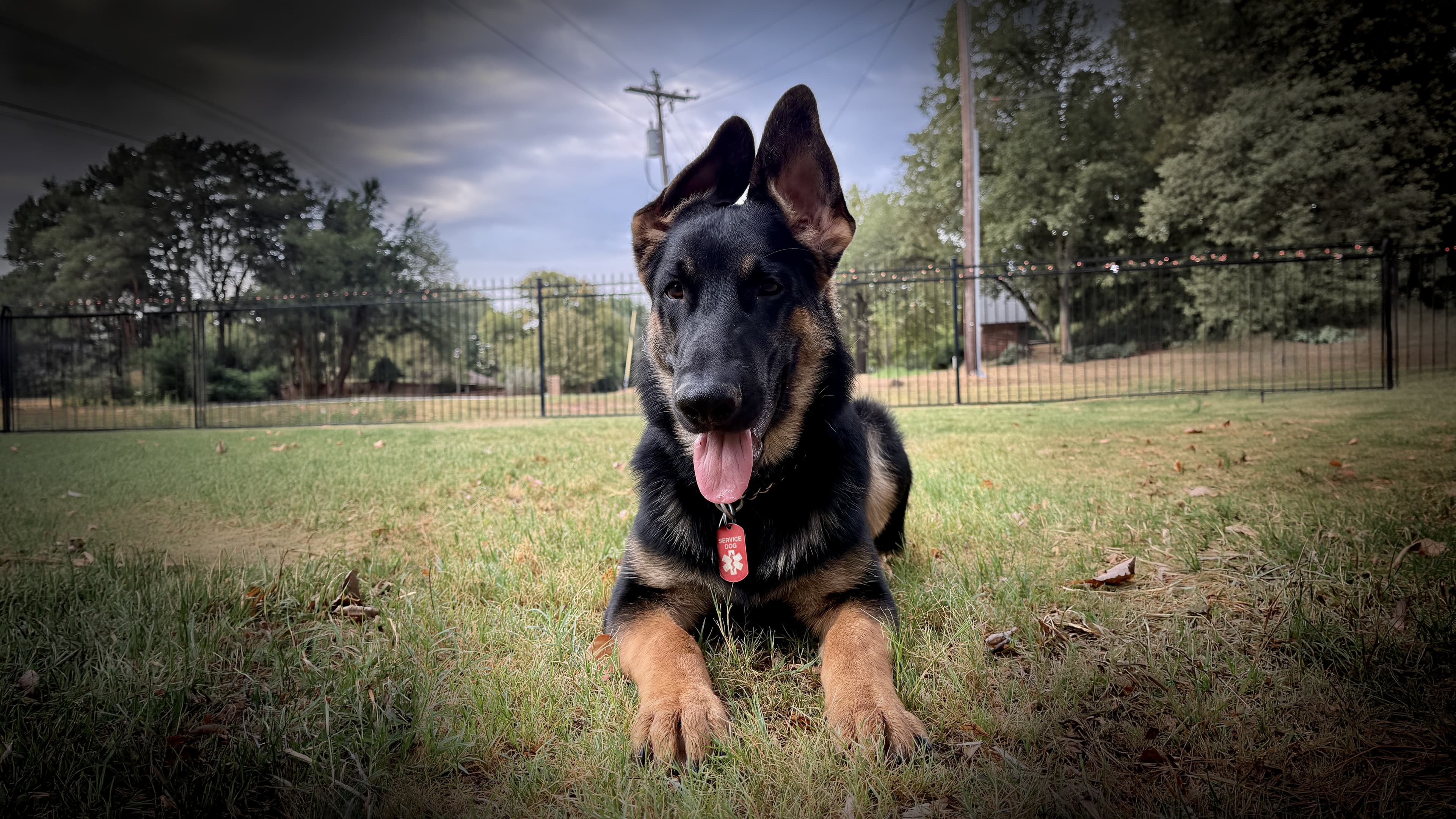
This week Charles hit six months. Officially. That soft little chunky monkey who learned sit for a piece of kibble has turned into a high-drive working dog with focus that still surprises me — and I've been doing this a long time.
As of this week, training starts in earnest.
He goes everywhere with me now. We tighten obedience. We tolerate less puppy nonsense. He still gets plenty of play. He's still a puppy. I'm not pretending otherwise. But he's proven he can lock in, and once a dog proves that, you stop treating every session like kindergarten.
Before I go any further: everything below is my circumstance, with this dog, for this job. Use it as an example of what can be done. Not a script for what you should do with yours. Every dog is different. Every job is different. If you copy my plan onto a dog who doesn't match it, that failure is on the plan, not on the animal.
I make mistakes. I made them with Charles too.
What worked at first
Charles has good food drive. As a puppy, that mattered. Food is clean. Easy to pocket. Easy to mark. For the early basics, it was the right tool.
I assumed it would be enough. And for a puppy with casual play and reward, it is. In a controlled environment where he has no better options, food is great.
Where there are other forces more interesting than food? It was not.
Example: playing in the front yard with his siblings, tearing the fence line like maniacs. He could not care less about me or my food. Want him back in the house? Nothing. Charles is borderline genius-level smart for a dog, and that kind of brain comes with stubborn built in. He would just sit in the yard and stare at me.
He still does that stare sometimes — even with the ball. Not because food failed again. Because he wants to keep working the ball, and right now ball work lives in the training area of the front yard. Ball work in the house with a dozen other dogs? Useless. It turns into a fight over who can catch it first.
So food got us through the baby chapter. It did not get us through real competition for his attention. That was my mistake: treating a good tool like it was the only tool.
What actually lights him up
His real drive is toy drive. Best-case scenario, honestly. Once we found that, the whole picture flipped.
I'm using a training ball on a rope — tough, heavy, small enough for a pocket. Mine's from RayAllen.com. Nothing fancy about the brand loyalty; it's just what fits my hand and survives him.
Here's the unpretty part. I've been bitten more than twenty times in three days while we learned the rules of the road together. He's never aiming for me. He wants the ball so hard he doesn't care that I'm in the way. The second he realizes he missed and got me instead, he lets go. Instantly.
So we adapted. Ball stays in my pocket unless he's being rewarded. That one rule saved both of us a lot of blood and frustration.
Two days
Two training sessions.
That's how long it took to go from a dog who barely paid attention and flat-out refused what I asked… to a dog who throws himself into a down, stares at me like the world narrowed to one person, and mostly ignores a strange dog walking past. Still aware of his surroundings. Still working. Eyes on me.
I want you to sit with that for a second. Not because I'm claiming magic. Because I want you to hear the other half of it: the method was wrong before it was right. He wasn't "stubborn" for no reason. I was paying him in a currency that lost to the yard, the fence, and his littermates.
When you find the thing your dog will move for — and you use it cleanly, in the right place — the dog you thought you had and the dog you actually have can look like two different animals.
What we're building now
I've got a solid come, down, sit, and alert.
I don't teach heel. Not for my service dogs. I want them free to move around me. I want them able to pull when the job needs it later — and I don't teach pulling until eighteen months because of structural concerns. What I do want is a dog who will lie down and stay exactly where I put him. And who will break that down or sit when the alert matters more than the stay.
We're still messy on passive alerts under a table. He's doing great otherwise. Real world is not a perfect training video. Under-table work will catch up because we keep showing up to the ugly reps, not because I found a prettier cue on the internet.
The moving target
That's the whole point of this post.
Training for real life is an ever-moving target. If you want to put ordinance on that target, you have to be willing to shift your decision-making when the dog tells you the truth. Food got us through the baby work. The ball got us into earnest work. Next month something else might need adjusting again. That isn't failure. That's partnership.
Charles proved he has ridiculous focus. Mid-play, I cough, and he comes running. That matters more to me than any pretty heel on a sidewalk nobody lives on.
He's still a puppy. He still gets to be one. The difference is we both know the job is real now.
Strength stands watch.
And so do I.
Wendi Coffman-Porter
Real handler, real stories, real dogs.
FurPower.org