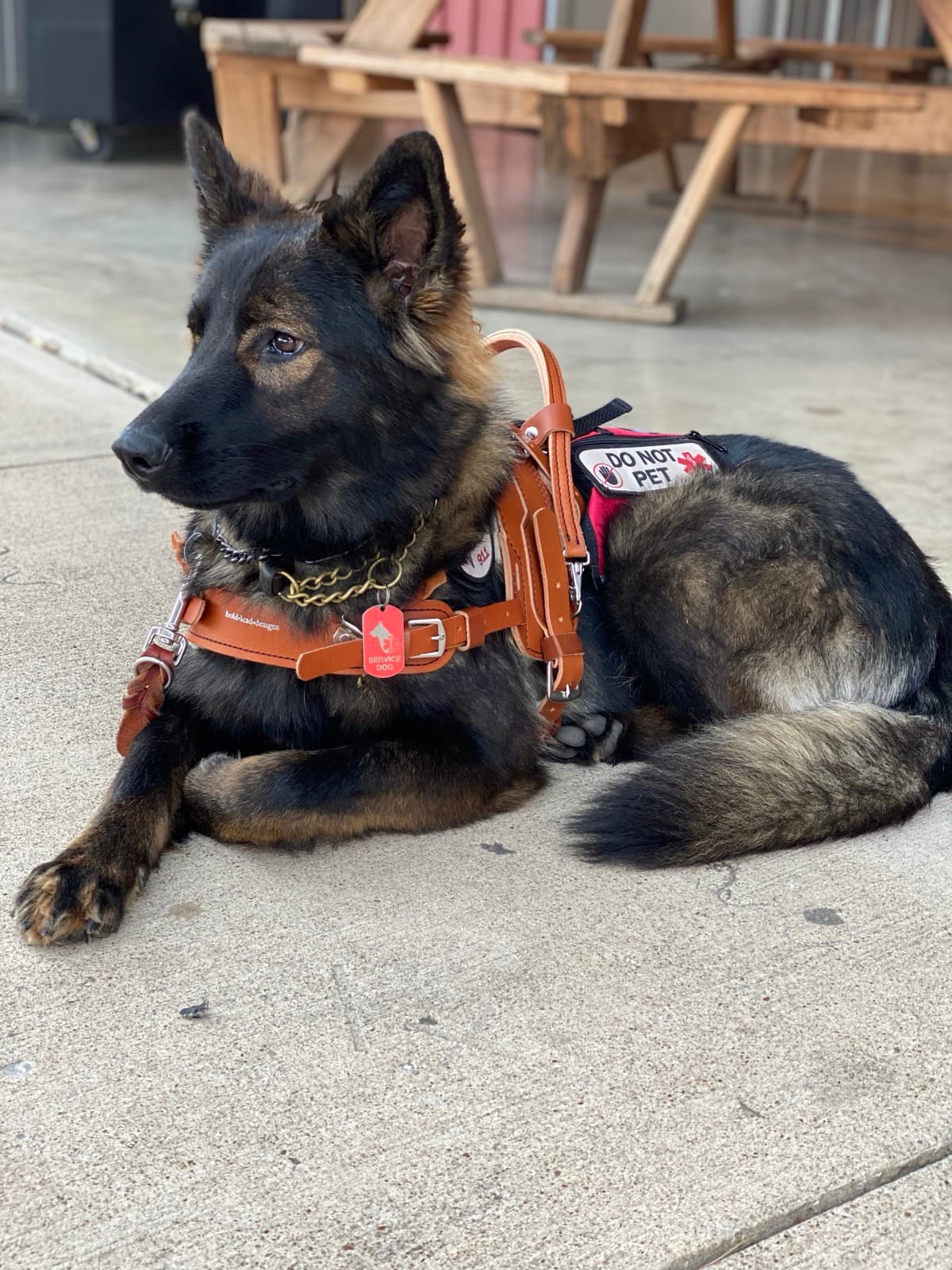
If you've ever been out in public with a service dog team, you know the question comes up constantly: "Can I pet your dog?" or "He's so cute—can I say hi?" It's well-meaning, but the answer is usually a polite (but firm) no. Here's why—and when there might be an exception.
Service dogs aren't pets. Under the Americans with Disabilities Act (ADA), they're individually trained to perform specific tasks that mitigate a person's disability. That means they're working medical equipment, not social butterflies. Distractions like petting, talking to, feeding, or even making eye contact can pull their focus away from their handler—at best it's annoying, at worst it could be dangerous.
Different types of service dogs have different focus needs, which directly affects whether petting is ever okay:
Medical alert dogs (e.g., diabetic alert, seizure alert, heart rate or other physiological changes): Almost always no. These dogs must stay hyper-focused on their handler's body chemistry or subtle cues 24/7 in public. A moment of distraction could mean missing a life-threatening alert. The dog literally cannot "take a break"—their job is constant vigilance.
PTSD or psychiatric service dogs: Also almost always no. Many are trained to interrupt panic attacks, provide deep pressure therapy, create personal space, or scan for threats. Breaking their concentration can leave the handler vulnerable during a high-stress moment. The dog's attention belongs entirely to their person.
Mobility assistance dogs (balance support, retrieval, door opening, bracing, etc.): This is where there's sometimes a yes—but with strict conditions. Many mobility teams (including the ones we train here at Fur Power) teach their dogs to ignore all other people and distractions unless the harness/vest is removed. That clear signal tells the dog: "Work mode off—social mode on." If the handler is seated and resting (like at a café table or bench), they might unclip the harness and give permission for gentle pets. But even then, always ask first—never reach out without the handler's explicit okay. And if the harness stays on? Hands off, no exceptions.
General etiquette rules for everyone:
When it's okay to ask: If the dog has a visible "Ask to Pet" patch or the handler looks relaxed and open, go ahead and politely ask the handler (not the dog!). But be prepared for "no" without taking it personally—it's not about you.
When the answer is almost always no (and why you shouldn't even ask most of the time): For the majority of service dog teams—especially alert, response, or psychiatric ones—asking itself can be a distraction. It forces the handler to stop what they're doing, respond, and possibly redirect the dog. Just admire from afar; that's the kindest thing you can do.
Why it matters: Petting or engaging a working service dog is like fiddling with someone's hearing aid, wheelchair controls, or insulin pump mid-use. It interferes with life-saving (or life-improving) work. The dog is there to keep their handler safe and independent—let's help by respecting their space.
Bottom line: Look, don't touch. Ask only if it feels appropriate (and even then, expect "no" more often than not). Service dogs are heroes in fur, and the best way to honor their work is to let them do it without interruption.
If you're a handler reading this and dealing with constant petting requests, feel free to share your go-to polite responses in the comments—we're all in this together.
Stay strong out there.
Strength stands watch.
And so do I.
Wendi Coffman-Porter 🐾
Real handler, real stories, real dogs.
FurPower.org