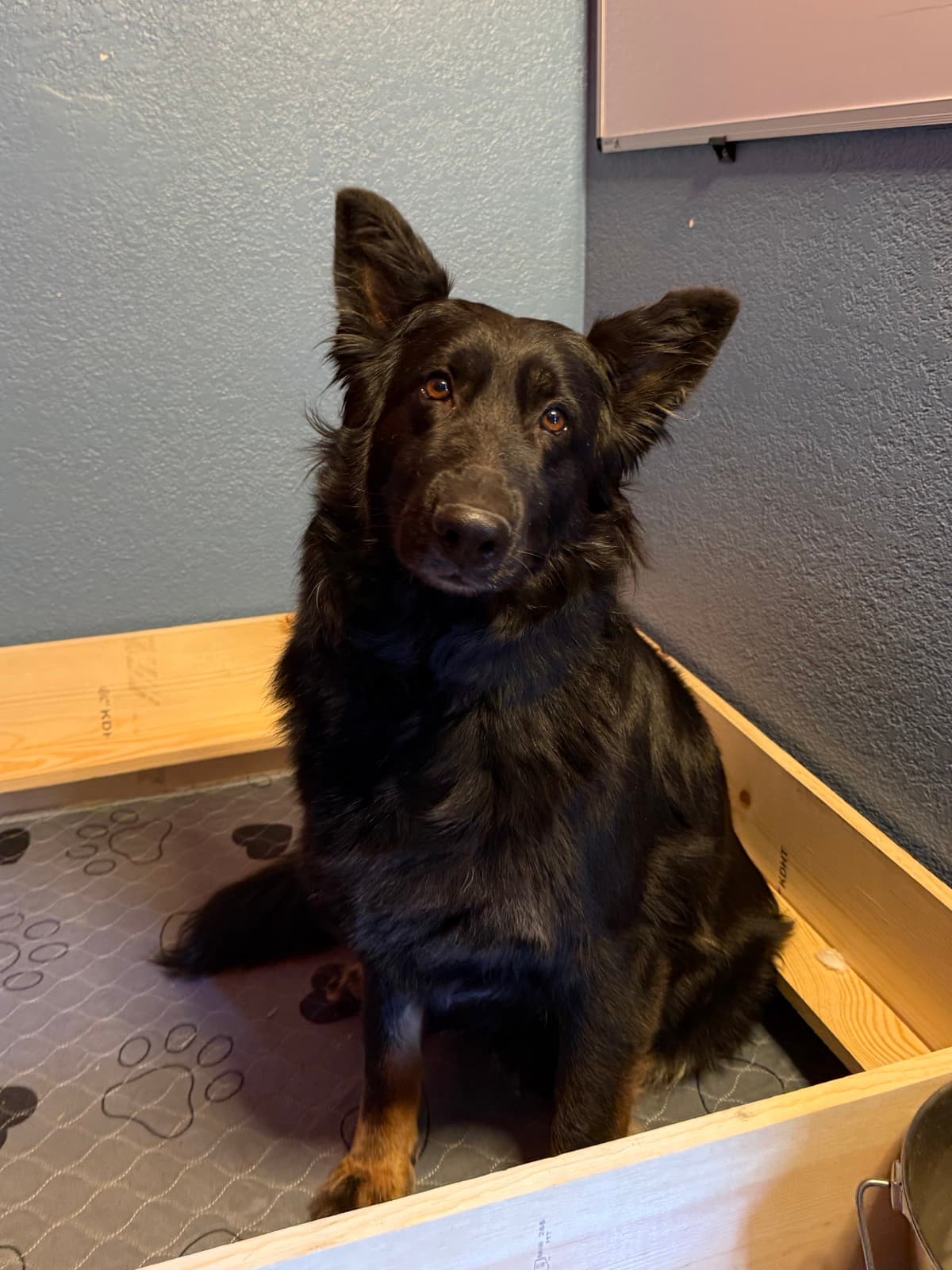
The litter is coming. That means the house is shifting. The whelping space is my office — where I can be with her for long periods of time. That is deliberate. The puppies will be exposed to movement and people talking around her constantly, and to all the other dogs in the house. We are not a kennel here. Everyone lives in the house with us. The dam and her litter get to grow up in the middle of life, not isolated from it. I do not believe in winging it. If I am going to raise puppies that have a shot at becoming the kind of partner I describe in these articles — alert, balanced, thoughtful, and ready for the chaos of real life — then the environment they are born into has to reflect that. So we are building it now, before a single pup arrives.
The whelping box and the office. The box itself is set up first. Momma needs to know it is her space. She needs to walk in, sniff it, lie in it, and decide that this is where she will have her babies. That does not happen in a day. We give her time. She gets fed in there. She gets treats in there. I sit with her in the office so she associates the space with safety and with us. No drama, no forced introductions — just repeated, calm exposure until the whelping box is as familiar as her own bed. Because when labor starts, it needs to be her bed. She needs to choose it. And the whole time, life goes on around her: voices, footsteps, other dogs passing by. She and the pups get used to it from day one.
The office itself: small, warm, and softly lit. I am not interested in a sterile, clinical setup. These are living beings entering the world. The lighting is warm. The space is contained. And because I will be spending nights there when the time comes, we have set up a military cot in the corner. I will be honest: I am not young anymore, and that cot by itself is brutal. So we added a memory foam pad. It is the difference between actually resting and lying there counting the hours until sunrise. If I am going to stay the night so momma and the pups are not alone — and I am — I need to be able to function the next day. So the cot gets the pad. Small detail, but it matters.
Access for her, not for chaos. One of the most practical decisions we made was to add a small run right outside the window of the office. She can go out to potty when she needs to without trekking through the whole house or leaving the pups in a stressful way. The run is secure, attached to the office, and available only to her. She learns the route now: out the window, do her business, back in. When the puppies arrive, she can step out, relieve herself, and return without the entire household becoming a parade. Quiet. Contained. Predictable.
Sleeping in the office. We do not wait until the first contraction to introduce her to the idea that this space is somewhere she will spend the night. Occasionally we already sleep in the office with her. She gets used to the sounds, the darkness, the fact that we are there. When the big night comes, it is not a strange building or a foreign crate. It is the same room where she has already rested with us. That familiarity is a gift to her and to the puppies. Less stress for her means a calmer birth and a calmer first few days of life for every pup.
Puppy playscapes: mind and body from the start. Once the puppies are mobile and exploring, they will move to a large glass room where their playscapes and training areas are set up — along with their crates, where they will learn to spend time. We will go more into that later as the pups get older. For now, the point is this: we are building playscapes — structured, interactive environments that engage both the mind and the body. I am not only raising future service-dog candidates; I am raising animals that need to think, adapt, and use their bodies with confidence. These are not just cute obstacles. They are deliberate.
The pups will climb up and over. They will crawl through. They will learn to use all four legs independently, not just run in a straight line on flat ground. They will encounter surfaces that are not the floor: textured, uneven, slightly unstable in a controlled way. They will learn balance. They will learn that height is a thing — safely, with low platforms and short steps — so that later in life, stairs, curbs, and novel footing are not a crisis. They will meet different textures, different colors, and different sounds as part of normal play. The world is full of surprises. I would rather those surprises start in a safe, built environment than in a parking lot or a busy store.
The goal is simple: by the time these puppies leave our care, their brains and their bodies have already been invited to solve problems. To balance. To navigate. To notice. That foundation makes everything that comes next — obedience, task work, public access, and the specific training we do for allergy alert and handler support — easier and more durable. A dog that has never had to figure out how to climb, crawl, or balance on something that moves a little is a dog that may freeze the first time life throws them a curve. I do not want that. So we build the curve into the playscape.
Strangers every day. After the first round of shots, we begin a deliberate socialization protocol. The puppies will meet new people every day. Not a crowd. Not chaos. One or a few strangers, introduced calmly and positively, so that human novelty becomes normal. The dog that will eventually work beside a veteran in a grocery store or sit quietly in an office cannot afford to be startled by the simple fact of an unfamiliar face. So we introduce that fact early, in a controlled way, and we repeat it. Strangers become part of the landscape. By the time we are evaluating which puppy will stay with me as my next service dog and which will go to other homes, every one of them has already had hundreds of small, positive experiences with the unpredictable thing called other people.
All of this — the whelping box in the office, life and other dogs moving around them, the cot with the memory foam pad, the run outside the window, the nights we spend there now so momma is at ease, the move to the glass room and playscapes that teach balance and bravery and problem-solving, and the daily stranger protocol after vaccines — is in service of one thing: giving these puppies the best possible start. So that when we choose the one who will stand watch beside me, and when we place the others with veterans and handlers who need them, every dog in this litter has already been met with intention. Not luck. Not hope. Preparation.
The litter is coming. We are ready.
Strength stands watch.
And so do I.
Wendi Coffman-Porter
Real handler, real stories, real dogs.
FurPower.org